Finish Shattered Glass--Turn in handout for classwork credit!
Sample Press Release:
http://www.publicityinsider.com/release.asp
Sample PSAs:
https://sites.google.com/site/teacherquality/psa
Thursday, November 1, 2012

Thursday, October 25, 2012
History of Journalism Quiz/Shattered Glass
Here are the websites to study for History of Journalism quiz:
http://www.flashcardmachine.com/history-of-journalism1.html
http://www.flashcardmachine.com/history-of-journalism2.html
http://www.flashcardmachine.com/history-of-journalism3.html
http://www.flashcardmachine.com/history-of-journalism1.html
http://www.flashcardmachine.com/history-of-journalism2.html
http://www.flashcardmachine.com/history-of-journalism3.html
Monday, October 22, 2012
Review Prezis/Media Ethics
Review of last week's Prezi presentations on the History of Journalism.
Quiz on Wednesday.
Nonetheless, professionals in the field generally take great pride and responsibility in their roles, and organizations such as the Associated Press and the Society of Professional Journalists offer thorough and useful guidelines for ethical conduct.
Generally, ethical concerns in the media can be grouped into a few broad categories. The following points synthesize and summarize some important ethical concerns proposed by the Associated Press and the Society of Professional Journalists.
“Society of Professional Journalists: Code of Ethics.” www.spj.org 18 Dec 2008. http://spj.org/ethicscode.asp.
Quiz on Wednesday.
Media Ethics
Summary: These resources
provide an overview of journalistic writing with explanations of the
most important and most often used elements of journalism and the
Associated Press style. This resource, revised according to The
Assocatied Press Stylebook 2011, offers examples for the general format
of AP style. For more information, please consult The Associated Press Stylebook 2011, 46th edition.
Contributors:Christopher Arnold, Tony Cook, Elizabeth Angeli
Last Edited: 2010-04-25 08:48:03
Contributors:Christopher Arnold, Tony Cook, Elizabeth Angeli
Last Edited: 2010-04-25 08:48:03
Introduction
The same First Amendment freedoms that allow U.S. media outlets to publish without fear of government interference also make it nearly impossible to impose a standard of ethics or professional protocol for journalists. No organization exists to certify journalists, and likewise, no uniform system exists for penalizing unethical behavior.Nonetheless, professionals in the field generally take great pride and responsibility in their roles, and organizations such as the Associated Press and the Society of Professional Journalists offer thorough and useful guidelines for ethical conduct.
Generally, ethical concerns in the media can be grouped into a few broad categories. The following points synthesize and summarize some important ethical concerns proposed by the Associated Press and the Society of Professional Journalists.
Accuracy
- Check the accuracy of information from all sources to avoid error.
- Subjects of news stories should always have the opportunity to respond to any allegations of wrongdoing.
- When mistakes are made, they must be corrected – fully and quickly.
- Headlines, news teases and promotional material, including photos, video, audio, graphics, sound bites and quotations, should never misrepresent, oversimplify, or highlight incidents out of context.
Treatment of Sources
- Identify sources whenever possible so that the public has as much information possible to determine the sources’ reliability.
- Always keep any promises made in return for the source’s cooperation.
- Only guarantee a source’s anonymity when the source insists upon it, when he or she provides vital information, when there is no other way to obtain that information, and when the source is knowledgeable and reliable.
- Strive to quote sources accurately and in the proper context.
Avoiding Bias
- Distinguish between advocacy and news reporting. Analysis and commentary should be labeled, and not misrepresent fact or context.
- Distinguish news from advertising and avoid hybrids that blur the two.
- Examine your own cultural values and avoid imposing those values on others.
- Avoid stereotyping by race, gender, age, religion, ethnicity, geography, sexual orientation, disability, physical appearance or social status.
- Support the open exchange of views, even views you might find repugnant.
Avoiding Distortions
- Never knowingly introduce false information into material intended for publication or broadcast.
- Never alter photo, video, or image content.
Gathering Information
- Avoid undercover or other surreptitious methods of gathering information, except when traditional open methods will not yield information vital to the public.
- Use of any non-traditional methods of gathering information should be explained as part of the story.
- Rely on the most up-to-date and accurate research when gathering facts for a story.
- Never plagiarize.
Minimizing Harm
- Show compassion for those who may be affected adversely by news coverage, especially children and inexperienced sources or subjects.
- Be sensitive when seeking or using interviews or photographs of those affected by tragedy or grief.
- Understand that private people have a greater expectation of privacy than do public officials and others who seek power, influence or attention.
- Be cautious about identifying juvenile suspects or victims of sex crimes.
- Be cautious about naming criminal suspects before the formal filing of charges.
Avoiding Conflicts of Interest
- Avoid conflicts of interest, real or perceived.
- Remain free of associations and activities that may compromise integrity or damage credibility.
- Always refuse gifts, favors, fees, free travel and special treatment.
- Avoid secondary employment, political involvement, public office, or service in community organizations if they compromise journalistic integrity.
- Disclose unavoidable conflicts.
- Deny favored treatment to advertisers and special interests.
- Be wary of sources offering information for favors or money.
Conclusion
There is no standard for ethical journalistic practice, but two widely regarded organizations, The Associated Press and the Society of Professional Journalists, offer useful and time-tested guidelines. When in doubt, always confer with a trusted colleague or supervisor.Sources
“The Associated Press Statement of News Values and Principles.” www.ap.org 16 Feb 2006. http://www.ap.org/newsvalues/index.html.“Society of Professional Journalists: Code of Ethics.” www.spj.org 18 Dec 2008. http://spj.org/ethicscode.asp.
Friday, October 5, 2012
Presidential Debate
Discussion of Presidential Debate and Media Punditry
What did you think?
Turn in handout.
Turn in missing work!
Continue to work on your Prezis!
What did you think?
Turn in handout.
Turn in missing work!
Continue to work on your Prezis!
Wednesday, October 3, 2012
Presidential Debate
http://www.pbs.org/newshour/topic/politics/
Background:Many Americans have not made up their minds about whom to vote for and the upcoming presidential and vice presidential debates will help them decide. Explain to your students that often viewers react to a candidate's performance-- how they look and act instead of what they say. This activity is designed to help them focus on what the candidates say and then look at how the media covers the debate and the consequent effect on public opinion.
Procedure:BEFORE THE DEBATE
1. Pass out the ballot based on the National Forensic League's public forum debates, and explain that this will help them focus on the substance of the debate instead of just the style.
2. Encourage them to take notes-- writing down each question and how the candidates answer it. These notes will be useful when the students are asked to defend the scores they give to the debaters. Remind them that the entire debate will be on the NewsHour's Election site the day after the debate, so they can replay key exchanges.
3. Suggest that the students refrain from watching "analysts" or "experts" on TV-- or read any post-debate analysis until after they have filled out their own ballot.
AFTER THE DEBATE
1. The day after the debate, go over the ballots in class. Are the ratings consistent or not? Students can discuss their ratings and use the RealAudio or a transcript on the Web to defend their arguments.
2. If you want, the class can write a critique of the debate and e-mail suggestions to the candidate's Web sites. (Also to NewsHour Extra for possible publication on the Web site.)
Media Coverage of the Debates
1. Ask students to pick a newspaper article or television show and fill out the following worksheet: How the Media Covers the Debates Students are asked to look for the criteria they used when rating the debaters' performances (analysis, evidence, reasoning, cross-fire, rebuttal, delivery) and then analyze what the media portrays as the most important part of the debate.
2. Students can then present their article and discuss the media coverage of the debates. (Examples of questions to foster discussion: Do you think the coverage is fair and accurate? Is it slanted one way or the other? Why might that be? How might you have done it differently?)
Tuesday, September 25, 2012
History of Journalism Prezi Project
Look over handout. Begin doing research with a partner.
A Brief History of Journalism in America
America's news media in 1776 barely resembled those of today and it's a safe bet the news media of 2076 will barely resemble those of today.
1690
America's first newspaper, Publick Occurrences, Both Foreign and Domestick, is published in Boston. It lasts for just one issue.
1769 In Connecticut, Isaac Doolittle builds the first printing press made in American.
1791 The First Amendment to the U.S. Constitution forbids Congress from making any law "abridging the freedom of speech, or of the press."
1823 A steam driven printing press is invented by Jonas Booth.
1833 America's first penny press newspaper is Benjamin Day's New York Sun. It attracts a wide audience.
1835 James Gordon Bennett's New York Herald becomes the most widely read newspaper in the United States.
1841 Horace Greeley publishes New York Tribune.
1844 A telegraph line stretches from Washington, D.C., to Baltimore, Maryland, makes it possible for newspapers to offer timely coverage of distant events.
1846 The U.S. Congress awards printing contracts to the lowest bidder. Previously, contracts had been given to loyal partisan printers.
1847 Robert Hoe's four-cylinder rotary press is capable of printing 8,000 pages per hour.
1849 A group of publishers start an organization to bring news from Europe. It will become the Associated Press (AP).
1859 The New York Clipper publishes the first baseball box score by Henry Chadwick. It lets newspapers standardize their game summaries.
1883 Joseph Pulitzer buys the New York World from Jay Gould for $346,000.
1887 George Hearst appoints his son William Randolph Hearst editor of the San Francisco Examiner.
1895 William Randolph Hearst buys the New York Morning Journal, renams it the New York Journal and converts it to a penny paper like James Gordon Bennett's New York Herald.
1897
The New York Journal publishes the first color Sunday comic pages.
1898 The New York Journal blames Spain for a mysterious explosion that sank the USS Maine in Havana Harbor, Cuba. That helps push the United States into war with Spain. The sensational coverage is an example of yellow journalism.
1904 William Randolph Hearst stars the Los Angeles Examiner and the Boston American. He will eventually starts and buys papers in many American cities. By 1930, his holdings will include 28 newspapers.
1911 Joseph Pulitzer's will leaves $2 million to Columbia University to establish a graduate school of journalism and the Pulitzer Prize. The prizes have been awarded since 1917 recognizing achievements in journalism, literature and music.
1920 Radio station KDKA begins broadcasting regularly scheduled programs at Pittsburgh, Pennsylvania.
1926
The U.S. begins regulating broadcasting with the Federal Radio Commission (FRC).
1934 The U.S. increases regulation of broadcasting with founding of the Federal Communications Commission (FCC).
1941 Orson Welles's movie about William Randolph Hearst, Citizen Kane, premieres in New York City.
1941 The FCC lets 18 television stations begin commercial broadcasting. CBS and NBC begin immediately. Hardly anybody watches. Station WCBW demonstrates the news potential with its bulletins on the Japanese attack on Pearl Harbor.
1948 More television stations begin broadcasting after the end of World War II and people begin to buy receivers and watch programs. Radio stations begin to switch from network entertainment programs to local DJ music shows.
1955 Compatible color television begins to catch on.
1969 The Pentagon invents a communication system that will become the Internet.
1971 The New York Times publishes Daniel Ellsberg's Pentagon Papers, series of classified government Vietnam War documents. President Richard Nixon gets a court injunction ordering The Times to stop publication of the document, but the U.S. Supreme Court finds the injunction is unconstitutional prior restraint.
1971 Washington Post reporters Bob Woodward and Carl Bernstein cover a burglary at the offices of the Democratic National Committee in Washington, D.C.'s Watergate Hotel. They eventually link the break-in to a dirty tricks campaign led by advisers to President Richard Nixon whose attempts to cover up the misdeeds lead to his own resignation in 1974.
1973 Australian Rupert Murdoch acquires his first American property, the San Antonio Express-News.
1980 Ted Turner starts the Cable News Network (CNN).
1988 The Internet opens to commercial users.
1989
Tim Berners-Lee begins to invent the World Wide Web on the Internet.
1993 Mosaic, the first World Wide Web browser, is relased.
1994 Public awareness of the World Wide Web – the information superhighway on the Internet – awakens with news coverage of its potential. Yahoo! opens.
1995 The wiki is invented.
1996 Rupert Murdoch starts Fox News Channel on cable TV.
1997 Blogging starts.
1998 Internet search engine Google starts up.
2000 Y2K is relatively uneventful. However, free online classified ads at Craigslist will grow to serve 500 cities with 30 million postings a month. This depletes newspaper classified ad sales, an important source of revenue.
2001 Wikipedia is created. Apple starts selling iPods.
2003 The virtual world Second Life is created on the Internet. MySpace starts.
2004 Facebook begins collecting friends. Flickr shares its first photographs. Podcasting starts. An Internet news aggregator, Digg.com, lets users determine which news stories are most important.
2005 The Huffington Post internet news site mixes professional news gathering, opinion reporting and user-generated content. YouTube begins sharing videos.
2006 Twitter begins to tweet.
2007
Rupert Murdoch purchases Dow Jones & Co., publisher of The Wall Street Journal.
2010 The Internet is well established as part of most Americans' news consumption. Two-thirds get some news online each day. Most also get news from other media. On the other hand, there are questions about print and local media and even whether there is a future for the mass-market magazine anymore.
2011 Advertising in local newspapers and on local television stations is down, while advertising on the Internet is up. Some newspapers have ceased publication of their print versions in recent years in favor of developing their online editions. Examples include the Pulitzer Prize winning Rocky Mountain News and the Seattle Post-Intelligencer.
America's news media in 1776 barely resembled those of today and it's a safe bet the news media of 2076 will barely resemble those of today.
| Publick Occurrences, Both Foreign and Domestick |
1769 In Connecticut, Isaac Doolittle builds the first printing press made in American.
1791 The First Amendment to the U.S. Constitution forbids Congress from making any law "abridging the freedom of speech, or of the press."
1823 A steam driven printing press is invented by Jonas Booth.
1833 America's first penny press newspaper is Benjamin Day's New York Sun. It attracts a wide audience.
1835 James Gordon Bennett's New York Herald becomes the most widely read newspaper in the United States.
1841 Horace Greeley publishes New York Tribune.
1844 A telegraph line stretches from Washington, D.C., to Baltimore, Maryland, makes it possible for newspapers to offer timely coverage of distant events.
1846 The U.S. Congress awards printing contracts to the lowest bidder. Previously, contracts had been given to loyal partisan printers.
1847 Robert Hoe's four-cylinder rotary press is capable of printing 8,000 pages per hour.
1849 A group of publishers start an organization to bring news from Europe. It will become the Associated Press (AP).
1859 The New York Clipper publishes the first baseball box score by Henry Chadwick. It lets newspapers standardize their game summaries.
1883 Joseph Pulitzer buys the New York World from Jay Gould for $346,000.
1887 George Hearst appoints his son William Randolph Hearst editor of the San Francisco Examiner.
1895 William Randolph Hearst buys the New York Morning Journal, renams it the New York Journal and converts it to a penny paper like James Gordon Bennett's New York Herald.

The Yellow Kid cartoon in 1898 click image to enlarge |
1898 The New York Journal blames Spain for a mysterious explosion that sank the USS Maine in Havana Harbor, Cuba. That helps push the United States into war with Spain. The sensational coverage is an example of yellow journalism.
1904 William Randolph Hearst stars the Los Angeles Examiner and the Boston American. He will eventually starts and buys papers in many American cities. By 1930, his holdings will include 28 newspapers.
1911 Joseph Pulitzer's will leaves $2 million to Columbia University to establish a graduate school of journalism and the Pulitzer Prize. The prizes have been awarded since 1917 recognizing achievements in journalism, literature and music.
1920 Radio station KDKA begins broadcasting regularly scheduled programs at Pittsburgh, Pennsylvania.
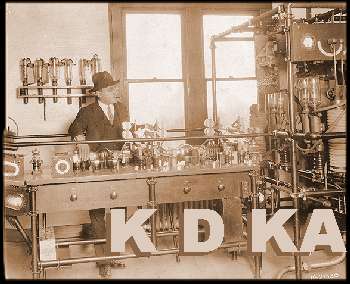
Radio Station KDKA in Pittsburgh in 1920 |
1934 The U.S. increases regulation of broadcasting with founding of the Federal Communications Commission (FCC).
1941 Orson Welles's movie about William Randolph Hearst, Citizen Kane, premieres in New York City.
1941 The FCC lets 18 television stations begin commercial broadcasting. CBS and NBC begin immediately. Hardly anybody watches. Station WCBW demonstrates the news potential with its bulletins on the Japanese attack on Pearl Harbor.
1948 More television stations begin broadcasting after the end of World War II and people begin to buy receivers and watch programs. Radio stations begin to switch from network entertainment programs to local DJ music shows.
1955 Compatible color television begins to catch on.
1969 The Pentagon invents a communication system that will become the Internet.
1971 The New York Times publishes Daniel Ellsberg's Pentagon Papers, series of classified government Vietnam War documents. President Richard Nixon gets a court injunction ordering The Times to stop publication of the document, but the U.S. Supreme Court finds the injunction is unconstitutional prior restraint.
1971 Washington Post reporters Bob Woodward and Carl Bernstein cover a burglary at the offices of the Democratic National Committee in Washington, D.C.'s Watergate Hotel. They eventually link the break-in to a dirty tricks campaign led by advisers to President Richard Nixon whose attempts to cover up the misdeeds lead to his own resignation in 1974.
1973 Australian Rupert Murdoch acquires his first American property, the San Antonio Express-News.
1980 Ted Turner starts the Cable News Network (CNN).
1988 The Internet opens to commercial users.

Time magazine cover April 12, 1993 |
1993 Mosaic, the first World Wide Web browser, is relased.
1994 Public awareness of the World Wide Web – the information superhighway on the Internet – awakens with news coverage of its potential. Yahoo! opens.
1995 The wiki is invented.
1996 Rupert Murdoch starts Fox News Channel on cable TV.
1997 Blogging starts.
1998 Internet search engine Google starts up.
2000 Y2K is relatively uneventful. However, free online classified ads at Craigslist will grow to serve 500 cities with 30 million postings a month. This depletes newspaper classified ad sales, an important source of revenue.
2001 Wikipedia is created. Apple starts selling iPods.
2003 The virtual world Second Life is created on the Internet. MySpace starts.
2004 Facebook begins collecting friends. Flickr shares its first photographs. Podcasting starts. An Internet news aggregator, Digg.com, lets users determine which news stories are most important.
2005 The Huffington Post internet news site mixes professional news gathering, opinion reporting and user-generated content. YouTube begins sharing videos.
2006 Twitter begins to tweet.

The Wall Street Journal |
2010 The Internet is well established as part of most Americans' news consumption. Two-thirds get some news online each day. Most also get news from other media. On the other hand, there are questions about print and local media and even whether there is a future for the mass-market magazine anymore.
2011 Advertising in local newspapers and on local television stations is down, while advertising on the Internet is up. Some newspapers have ceased publication of their print versions in recent years in favor of developing their online editions. Examples include the Pulitzer Prize winning Rocky Mountain News and the Seattle Post-Intelligencer.
Friday, September 21, 2012
News Judgment
1: Terms to Know (Examples would clarify understanding here)
News Judgment- a journalist uses their judgment to decide if a story will be good enough to put in the news
Advance- promoting the time in which the story accured
Timeliness- relates to the newness of facts -> how current are the facts
Proximity-refers to the nearness of the story-> meaning where the story took place in location
Prominence- refers to the “newsworthiness” of the story (names-some create more news then others)
Consequence- simply refers to the importance of the story--events
Localization-defines where something is going on/taking place
Human-Interest Story- deals with other human interactions and it is one of the most popular types of story
Conflict-an element of news that deals with conflict
Brainstorming- helps a writer figure out what type of story to write about
Random Sample- samples that are taken at random from the public
Filter Question- Questions that require a yes or no answer in order to narrow down facts to gain the most important information.
2: Key Concepts
News Judgment: Using ones sense of judgment by deciding what is more important in the mass media. This is something that is learned from experience.Example: A journalist has a list of 12 articles, They decide what needs to be heard first.
The “Who cares method”: The journalists ask themselves “who cares bout this topic? Whom does this relate to?” If it is something that there is genuine interest then it is news.
The Element of News: Timeliness, Proximity, Prominence, Consequence, Human interest, Conflict, Other
Generating News Story Ideas: Come up with possible newsworthy stories and who would be interested in them.
Subscribe to:
Posts (Atom)